You film in the same room every week. Same corner, same phone, same distance. The content changes and the picture doesn’t, and somewhere around the fourth video you start to feel it going flat — technically fine, emotionally nothing.
You can’t rent a location and you’re not buying a gimbal. What you can do is roll your wrists twenty degrees. A dutch angle is the one camera move that costs nothing, needs no equipment, and changes how a shot feels in under a second. It’s also the one most creators get wrong, because a tilt that isn’t earned just looks like you knocked the tripod.
What a dutch angle actually is
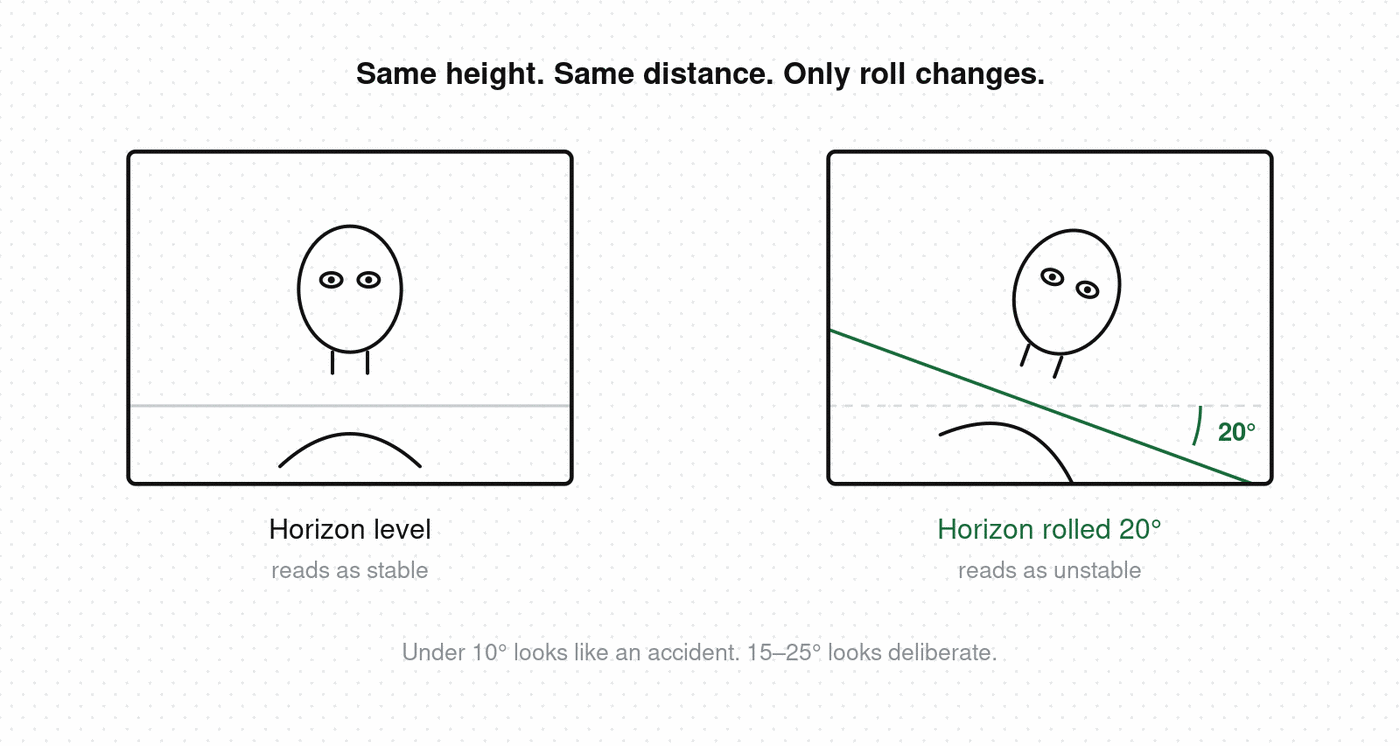
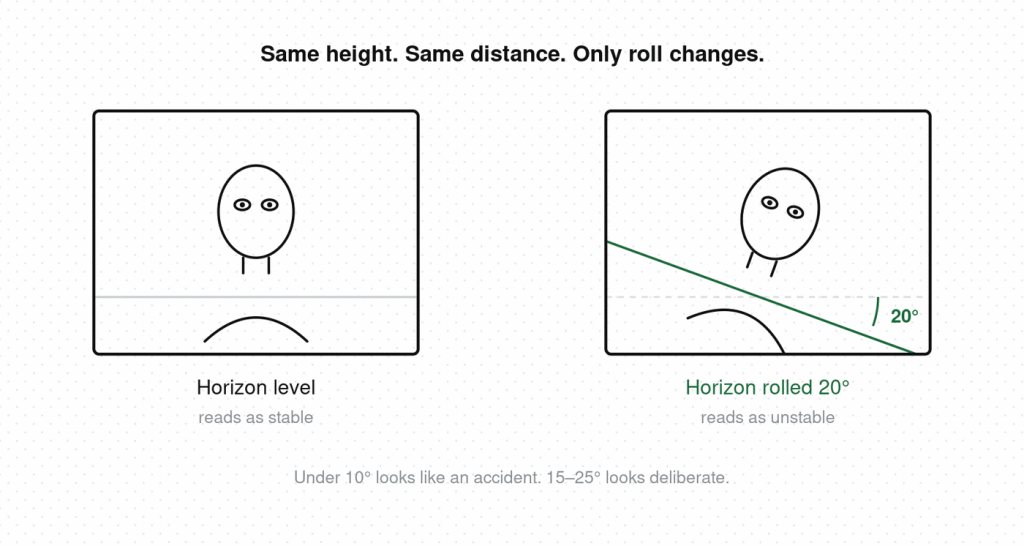
A dutch angle is a shot where the camera is rolled along its lens axis, tilting the horizon off level. It also goes by canted angle or oblique angle.
The important part is what it leaves alone. Camera height stays the same. Distance stays the same. The subject sits in the same place in the frame. Roll is the only variable that moves.
That isolation is why it reads so loudly. Every other cue in the shot says normal, and one says something here is wrong.
Camera angle is a relationship
I’ve been shooting and posting video for about ten years. Alongside a career in game and IP operations and supply-chain work, I’ve been making my own content that entire time, and the lesson that took me longest to learn is that camera angle is a statement about the relationship between the viewer and the person on screen.
High angle reads as surveillance
I used to shoot everything from above. Ten-odd years ago that look was everywhere — the Y2K revival leaned on it hard, and I liked how it flattered a frame.
What I eventually noticed is that it kept getting in the way of connecting with an audience. Looking down at someone anchors the viewer’s perception to a security camera. They’re observing the subject from above, slightly removed, slightly in charge. It’s a strong angle for making someone look small or watched. It’s a weak angle for talking to a person.
Eye level reads as equal
Eye level puts viewer and subject on the same plane — equal status, equal footing, the same emotional register. It’s the angle of conversation, which is why talking straight to camera works from eye level and falls apart from anywhere else.
Low angle reads as authority
Shooting slightly up at someone signals power, and people respond to it more than most creators expect. When I film knowledge-sharing content, I set the camera a few degrees below my eyeline on purpose. A mild low angle lends weight to what I’m saying without the shot announcing itself.
All three live on one axis: camera height. The dutch angle sits on a different axis entirely. It makes no claim about status. It says the ground itself is unreliable.
You’ve felt this land on videos you scrolled past — a frame that made you uneasy a beat before you could say why. Those are worth keeping. Hookova saves any TikTok, Reel, or Short into a sorted library in one click, then breaks it down shot by shot with the camera and framing notes attached, so a tilt you noticed becomes something you can measure and copy.
Where the tilt goes in your format
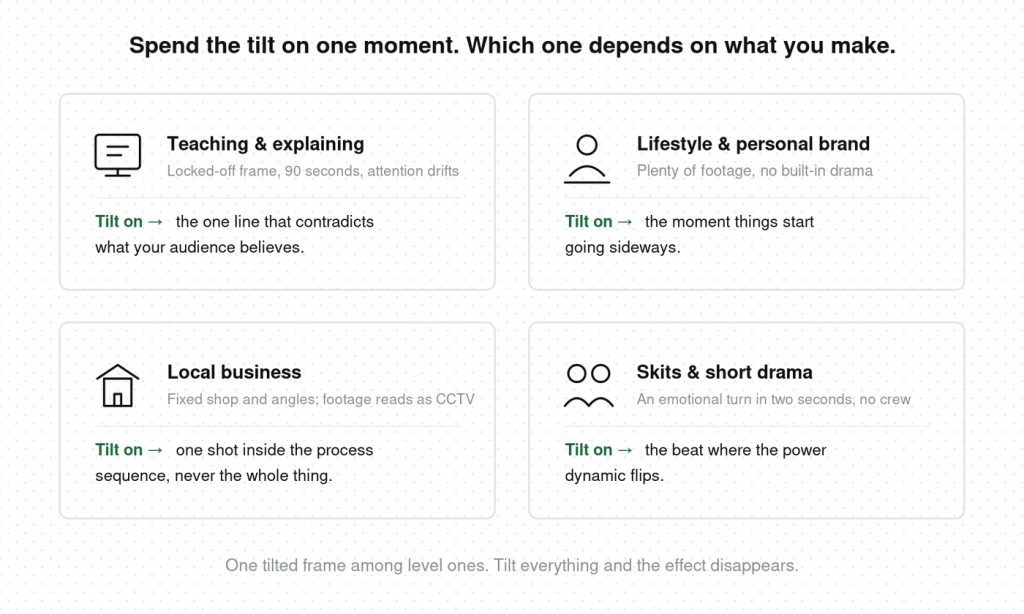
The technique is the same. The moment you spend it on depends entirely on what you make.
If you teach or explain things. Your problem is a locked-off talking-head frame that stays visually identical for ninety seconds while the information does all the work. Attention drifts even when the content is good. Spend the tilt on the one sentence that contradicts what your audience believes — the “most people get this backwards” line. One canted frame, held for that sentence, then back to level. The tilt marks which claim matters and breaks the visual stillness at the same time.
If you make lifestyle or personal-brand content. Your problem is the opposite: plenty of footage, no built-in drama. A day at the market is not a story. Spend the tilt on the moment things start going sideways — the train you miss, the recipe that collapses, the plan that changes. It converts an ordinary clip into a beat with a turn in it, and viewers feel the shift before the voiceover explains it.
If you film for a local business. Your problem is that every video looks the same because the shop looks the same. Fixed counter, fixed lighting, fixed angles, and the process footage starts resembling CCTV. Spend the tilt on one shot inside the sequence — the moment the espresso pulls, the clippers come out, the tray goes in the oven. A single canted frame breaks the surveillance read that a static shop camera falls into naturally.
If you make skits or short drama. Your problem is compressing an emotional turn into two seconds without a crew. Spend the tilt on the reversal — the beat where the power dynamic flips and one character realizes they’ve lost. In scripted skits, audiences read a tilt as the visual equivalent of a record scratch. It does the job a reaction shot would, without needing coverage you didn’t film.
Four times it reads as a mistake
A calm scene with nothing at stake. The tilt announces instability. If the scene contains none, viewers register a crooked frame and nothing else.
A talking-head shot you want trust from. Direct address depends on the viewer feeling addressed as an equal. Rolling the horizon breaks that read instantly — fine for the one contradiction line above, wrong for the other eighty seconds.
A tilt under about 10 degrees. The single most common error. Five degrees looks like an accident every time. Commit to 15–25 degrees so the choice is unmistakably deliberate.
Every shot in the video. A dutch angle works by contrast with level shots. Tilt everything and the technique disappears — the viewer recalibrates and diagonal becomes the new normal.
How to shoot one on a phone
Handheld is fine, often better. Roll your wrists to set the tilt, then hold it steady — a canted shot that also drifts reads as a mistake twice over.
Turn on your camera app’s grid and use it in reverse: line the horizon up against a grid line, then roll deliberately past it until the offset is obvious. Judging tilt by eye almost always lands in that dead zone under 10 degrees.
Shoot the level version too. You’ll want the option in the edit, and cutting between level and tilted is where most of the effect actually comes from.
Lighting carries more weight here than in a level shot, because a canted frame already asks the viewer to work harder. Add harsh, uneven lighting on top and the shot stops reading as a deliberate choice.
FAQ
What is a dutch angle used for?
Signalling instability, disorientation, tension, or unease. It’s a subjective device — it tells the viewer something is wrong with the situation or with the character’s state of mind, without anyone saying so.
Why is it called a dutch angle?
The name comes from Deutsch, referring to the German Expressionist filmmakers of the 1920s who used canted framing heavily. It has no connection to the Netherlands — the term is a mistranslation that stuck.
How many degrees should a dutch angle be?
15–25 degrees for a clearly intentional tilt. Under about 10 degrees reads as an accident, and past 35 degrees the shot becomes hard to follow because the viewer loses their spatial reference.
What’s the difference between a dutch angle and a low angle?
A low angle changes where the camera sits — below the subject, looking up, which reads as power. A dutch angle changes the roll of the horizon while the camera stays where it is, which reads as instability. They’re independent controls and can be combined.
Can you add a dutch angle in post?
You can rotate a clip in editing, but you’ll crop in and lose resolution at the corners. Shooting it in camera keeps the full frame and lets you match the tilt to the performance while filming, which is usually where the timing has to come from.
Does a dutch angle work in vertical video?
Yes, and arguably better than in horizontal. Vertical frames have long straight edges running down both sides, so any deviation from level is immediately visible on a phone screen.
The tilt is easy to spot once you know it exists. What’s harder is judging whether the one in your own footage is doing anything, or whether it’s a crooked frame you talked yourself into. Hookova breaks a finished cut down second by second with framing and camera notes on every shot, so you can check whether the choice reads the way you intended. For the full range of opening techniques it recognizes, see the video hooks guide.