You’re in the edit, hovering over twelve seconds of footage, trying to decide whether it stays. So you search for the right Shorts length and get a range back — fifteen to thirty seconds, or thirty to sixty, depending who you ask.
Those numbers are real, and they’re describing other people’s finished videos. They can’t tell you whether your twelve seconds belongs, because length is the output of a decision you haven’t made yet.
What the algorithm actually measures
Distribution runs on completion percentage. Total duration barely enters into it. A twenty-second Short watched to the end beats a sixty-second Short abandoned at twenty-four, even though the second one accumulated more total watch time.
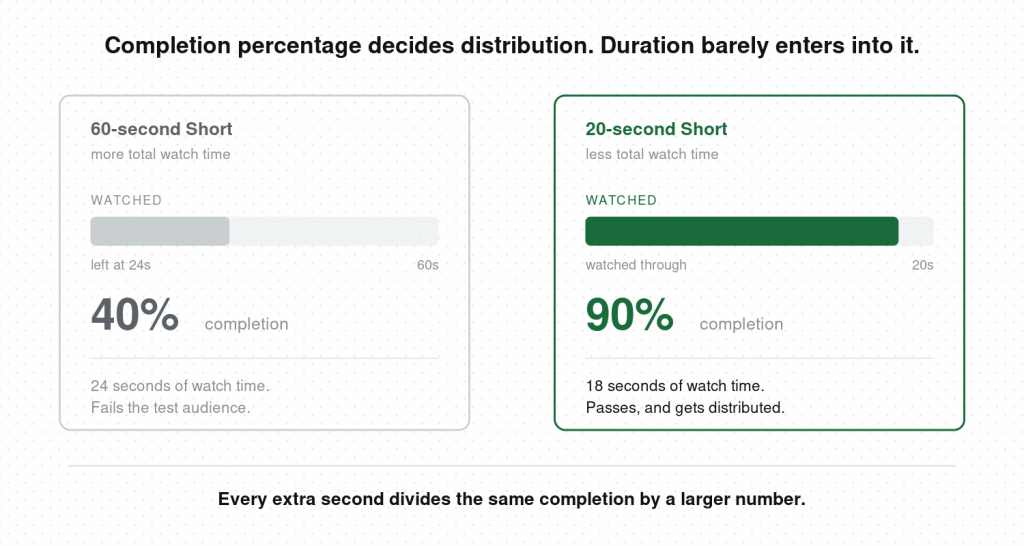
That single fact reverses the whole question. Every extra second you keep has to earn its place, because it’s dividing the same completion by a larger number.
The mechanism is worth knowing. Your video goes to a small test audience first, and how that group behaves decides whether anyone else sees it. Completion is the cleanest signal available in that window, and longer videos simply have more places to lose the test group.
Analyses of large Shorts samples land in a consistent place: the 15–30 second band tends to produce the highest completion rates, often above 80%, while narrative content in the 50–60 second range holds up well when the story justifies the runtime. Both findings say the same thing from different directions — the length that works is the length the content needed.
One quirk worth knowing: retention on Shorts can exceed 100%, because loops and replays count. A very short video that loops seamlessly is one of the few ways to beat the ceiling.
The rule that replaces the number
Your opening makes a promise. Your Short should run exactly as long as it takes to deliver that promise, and stop there.
That’s it. The practical version is a two-pass edit:
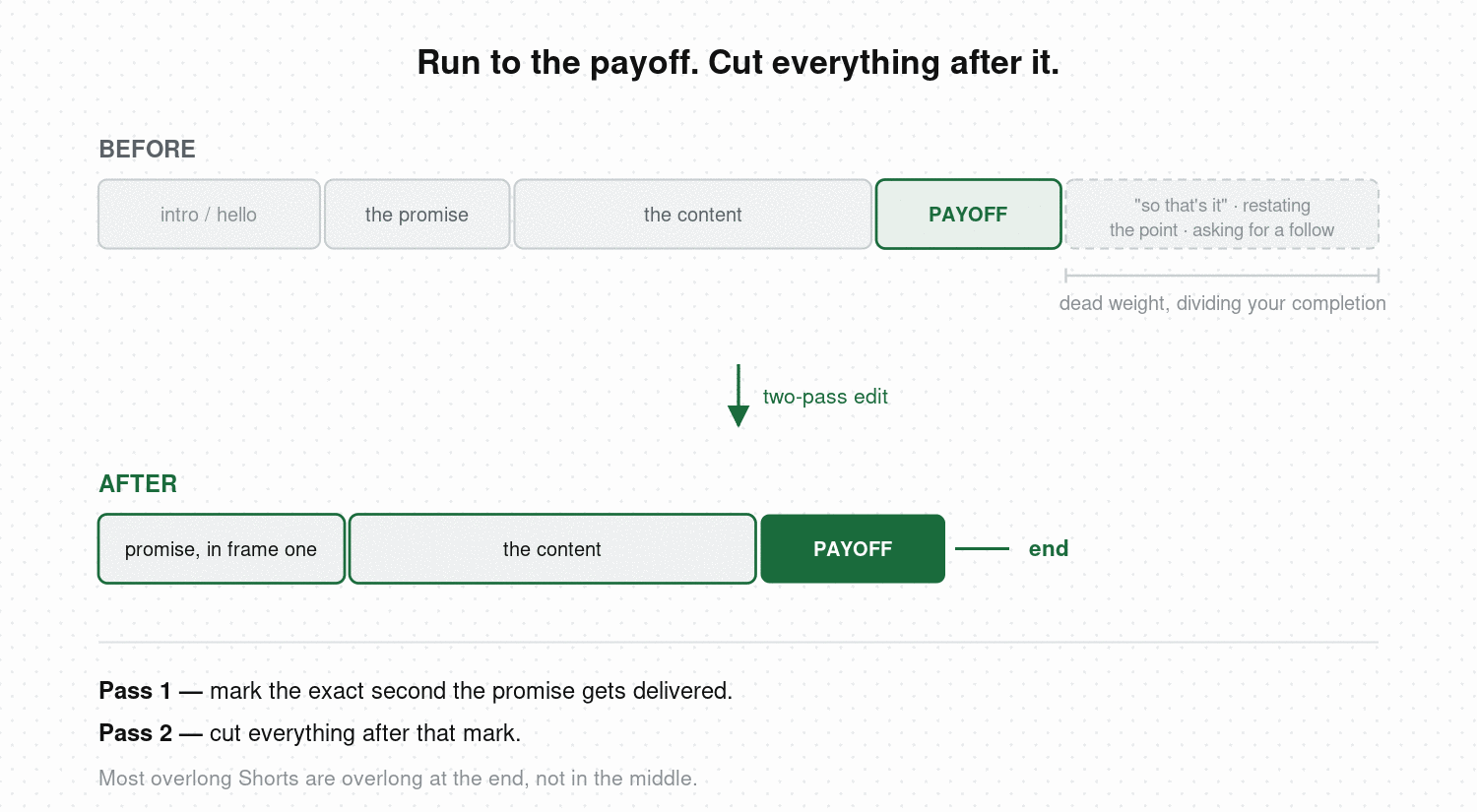
First pass — find the payoff. Identify the exact moment the promise made in your opening gets delivered. Mark it.
Second pass — cut everything after it. Sign-offs, “so that’s it,” restating the point, asking for a follow. Every one of those sits after the payoff and pushes your completion rate down while adding nothing.
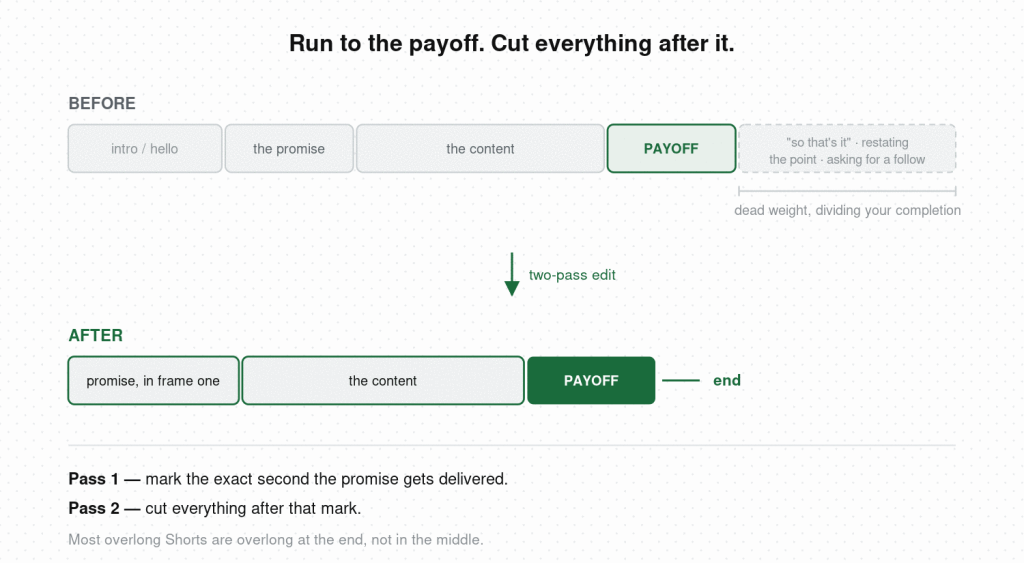
Most overlong Shorts aren’t overlong in the middle. They’re overlong at the end, because the creator kept talking after the video was over.
You’ll notice this pattern once you go looking — the videos that hold you almost always end a beat sooner than feels comfortable. Hookova makes that measurable: save any Short in one click and it comes back broken down second by second, so you can see exactly where the payoff lands and how much runtime the creator left after it.
How long yours should run, by what you make
If you teach or explain things. Your risk is packing three ideas into one video because you want to give full value. Three ideas need a payoff three times, and completion is set by whoever leaves first. One point per Short, 20–40 seconds. The test: can you state what the viewer walks away knowing in one sentence? If it takes two, you have two videos.
If you make lifestyle or vlog content. Your risk is footage volume — forty clips, each one feeling like it belongs. Ask every clip what it does for the promise the opening made. Most day-in-the-life Shorts work best at 20–35 seconds, and the long ones usually have three good moments fighting for one slot. Split them and let each keep its own opening.
If you film for a local business. Fifteen to twenty-five seconds covers a transformation, a process, or one insider detail. Longer reads as an advert, and viewers exit adverts faster than anything else. Show the result, show two or three steps, name the shop, end. Opening hours and the other services belong in the caption, where they cost no runtime.
If you make skits or short drama. Structure sets the length. The video ends on the turn — the beat where the power dynamic flips — plus a short reaction, and nothing after. Scripted formats usually land between 15 and 45 seconds, and the ones that overrun are explaining the joke after it landed.
Where the seconds actually go
Two habits account for most wasted runtime.
The intro that isn’t the hook. Any second spent introducing yourself, the topic, or the video is a second before the promise gets made. Cut in at the moment of tension and let context arrive late.
The trailing wrap-up. Watch your last five seconds and ask whether a viewer would notice if they were gone. If the answer is no, they’re actively costing you — those seconds are the ones dragging your completion percentage down.
There’s a related trap in the middle: silence and dead frames. A static frame with no visual change reads as longer than it is, so a 30-second Short with three cuts often feels shorter than a 20-second locked-off shot. Perceived length matters as much as actual length.
What your view count is telling you
Completion rate decides distribution, and it’s also the number you can’t watch while a video is live. What you can watch is the view count. After running a lot of new accounts, I’ve found it maps onto specific problems closely enough to use as a diagnostic.
These are my own observed thresholds for new accounts. Platforms publish none of this, and established accounts behave differently.
20–30 views. Something is wrong at the account level. This usually points to restricted distribution — the video never reached a real test audience, so its content barely got judged.
Around 100 views (Instagram). It reached the test pool and failed. In practice that means the premise was unclear, there was no hook, and nothing visual gave anyone a reason to stop. A video sitting here usually has all three problems at once.
200–300 views. You cleared the basics. The video isn’t padded, and enough people watched through that the algorithm took a second look. Nobody bailed inside two seconds.
300 and up. The content carries real value and has a small tail. Completion is holding through to the end.
Everything from 100 to 300 is still the entry pool. Getting out of it is the threshold that counts, and it differs by platform:
- Instagram — 1,000 views is the line. Break it and you’ve hit the ceiling of the entry pool.
- YouTube Shorts — competition is lighter and the platform is pushing the format hard right now, so a basically competent video tends to land near 1,000 on its own. Going further takes finer work, and videos that manage it usually settle around 2,000–3,000.
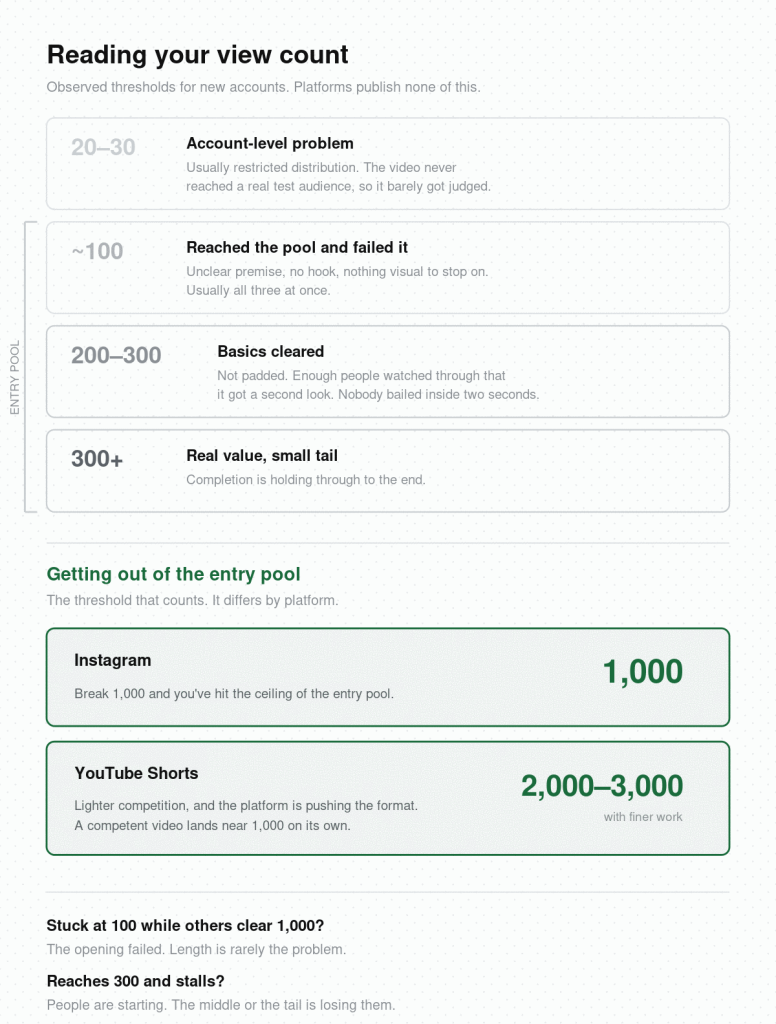
Here’s how this connects back to length. A video stuck at 100 while your others clear 1,000 rarely has a length problem — the opening failed. A video that reaches 300 and stalls is where length usually is the culprit: people are starting, and something in the middle or the tail is losing them before the end.
To confirm which, post the same content at two lengths a week apart and compare completion rate. Change only the length — same hook, same footage, same on-screen text — or you’ll learn nothing about either variable.
FAQ
How long can a YouTube Short be?
Up to three minutes. That’s the platform ceiling. Most Shorts that perform well run far under it, because completion percentage falls as duration rises unless the content genuinely holds attention throughout.
What is a good retention rate for Shorts?
Roughly 70–85% is strong, and above 85% is exceptional. For Shorts under 30 seconds, aim for completion above 60%. These are directional benchmarks — your own baseline across ten videos is more useful than any published average.
Can a Short be too short?
Yes, if it ends before the promise is delivered — viewers register that they missed something and it reads as a mistake. Below about eight seconds there’s rarely room to set up and pay off anything, though loop-based formats are an exception.
Does Shorts length affect monetization?
Length itself isn’t a monetization lever. Watch time and engagement drive revenue, and both follow completion — a shorter video people finish generally earns more than a longer one they abandon.
How does Shorts length compare to TikTok?
The psychology is the same and the tolerance differs slightly — TikTok audiences accept longer storytelling formats, YouTube Shorts viewers arrive with more search-and-scan intent. If you post the same cut to both, the tighter version usually travels better on Shorts.
Why is my retention over 100%?
Loops and replays count toward watch time, so a video watched twice registers above 100%. Short, seamlessly looping videos are the main way this happens, and it’s a strong signal to the algorithm.
Deciding length by feel works until you’re editing on a deadline and every clip seems necessary. Hookova breaks a finished video down second by second — where the promise is made, where it’s delivered, and what’s still running afterwards — so you can see the structure of videos that held you and cut yours against the same shape. For the full range of opening techniques it recognizes, see the video hooks guide.